Decoupling Temporal Services with Nexus
Author: Nikolay Advolodkin | Editor: Angela Zhou
In this walkthrough, you'll take a monolithic Temporal application — where Payments and Compliance share a single Worker — and split it into two independently deployable services connected through Temporal Nexus.
You'll define a shared service contract, implement a synchronous Nexus handler, and rewire the caller — all while keeping the exact same business logic and workflow behavior. By the end, you'll understand how Nexus lets teams decouple without sacrificing durability.
What you'll learn
- Register a Nexus Endpoint using the Temporal CLI
- Define a shared Nexus Service contract between teams with
@Serviceand@Operation - Implement a synchronous Nexus handler with
@ServiceImpland@OperationImpl - Swap a local Activity call for a durable cross-team Nexus call
- Inspect Nexus operations in the Web UI Event History
Prerequisites
Before you begin this walkthrough, ensure you have:
- Knowledge of Java
- Knowledge of Temporal including Workflows, Activities, and Workers
- Clone this repository
Scenario
You work at a bank where every payment flows through three steps:
- Validate the payment (amount, accounts)
- Check compliance (risk assessment, sanctions screening)
- Execute the payment (call the gateway)
Two teams split this work:
| Team | Owns | Task Queue |
|---|---|---|
| Payments | Steps 1 & 3 — validate and execute | payments-processing |
| Compliance | Step 2 — risk assessment & regulatory checks | compliance-risk |
The Problem
Right now, both teams' code runs on the same Worker. One process. One deployment. One blast radius.
Use the interactive diagram below to why this matters:
That's a problem because the Compliance team deals with sensitive regulatory work — OFAC sanctions screening, anti-money laundering (AML) monitoring, risk decisions — that requires stricter access controls, separate audit trails, and its own release cycle. Payments has none of those constraints. But because both teams share a single process, they're forced into the same failure domain, the same security perimeter, and the same deploy pipeline.
In practice, that shared fate plays out like this: Compliance ships a bug at 3 AM. Their code crashes. But it's running on the Payments Worker — so Payments goes down too. Same blast radius. Same 3 AM page. Two teams, one shared fate.
The obvious fix is splitting them into microservices with REST calls. But that introduces a new problem: if Compliance is down when Payments calls it, the request is lost. No retries. No durability. You're writing your own retry loops, circuit breakers, and dead letter queues. You've traded one problem for three.
The Solution: Temporal Nexus
Nexus gives you team boundaries with durability. Each team gets its own Worker, its own deployment pipeline, its own security perimeter, its own blast radius — while Temporal manages the durable, type-safe calls between them.
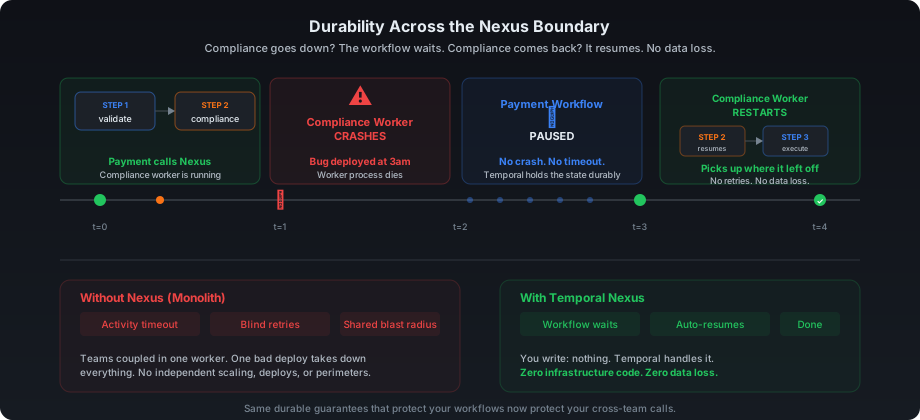
The Payments workflow calls the Compliance team through a Nexus operation. If the Compliance Worker goes down mid-call, the payment workflow just...waits. When Compliance comes back, it picks up exactly where it left off. No retry logic. No data loss. No 3am page for the Payments team.
The best part? The code change is almost invisible:
// BEFORE (monolith — direct activity call):
ComplianceResult compliance = complianceActivity.checkCompliance(compReq);

// AFTER (Nexus — durable cross-team call):
ComplianceResult compliance = complianceService.checkCompliance(compReq);
Same method name. Same input. Same output. Completely different architecture.
Here's what happens when the Compliance Worker goes down mid-call — and why it doesn't matter:
Why Nexus over REST or a shared Activity?
You could split Payments and Compliance into microservices with REST calls. But then you'd write your own retry loops, circuit breakers, and dead letter queues. Here's how the options compare:
| REST / HTTP | Direct Temporal Activity | Temporal Nexus | |
|---|---|---|---|
| Worker goes down | Request lost, manual retry | Same crash domain | Workflow pauses, auto-resumes |
| Retry logic | Write it yourself | Temporal retries within team | Built-in across the boundary |
| Type safety | OpenAPI + code gen | Java interface | Shared Java interface |
| Human review | Custom callback URLs | Couple teams together | @UpdateMethod, durable wait |
| Team independence | Shared failure domain | Shared deployment | Separate Workers, blast radii |
| Code change | Full rewrite | — | One-line stub swap |
New to Nexus? Try the Nexus Quick Start for a faster path. Come back here for the full decoupling exercise.
Overview

The Payments team owns validation and execution (left). The Compliance team owns risk assessment, isolated behind a Nexus boundary (right). Data flows left-to-right — and if the Compliance side goes down mid-check, the payment resumes when it comes back.
What You'll Build
You'll start with a monolith where everything — the payment workflow, payment activities, and compliance checks — runs on a single Worker. By the end, you'll have two independent Workers: one for Payments and one for Compliance, communicating through a Nexus boundary.
BEFORE (Monolith):                    AFTER (Nexus Decoupled):
┌─────────────────────────┐           ┌──────────────┐    ┌──────────────┐
│   Single Worker         │           │  Payments    │    │  Compliance  │
│   ─────────────         │           │  Worker      │    │  Worker      │
│   Workflow              │           │  ──────      │    │  ──────      │
│   PaymentActivity       │    →      │  Workflow    │◄──►│  NexusHandler│
│   ComplianceActivity    │           │  PaymentAct  │    │  Checker     │
│                         │           │              │    │              │
│   ONE blast radius      │           │  Blast #1    │    │  Blast #2    │
└─────────────────────────┘           └──────────────┘    └──────────────┘
                                                   ▲ Nexus ▲
Checkpoint 0: Run the Monolith
Don't forget to clone this repo for the exercise!
Before changing anything, let's see the system working. You need 3 terminal windows and a running Temporal server. Navigate into the java/decouple-monolith/exercise directory.
Terminal 0 — Temporal Server (if not already running):
temporal server start-dev
Create namespaces (one-time setup):
temporal operator namespace create --namespace payments-namespace
temporal operator namespace create --namespace compliance-namespace
Terminal 1 — Start the monolith Worker:
cd exercise
mvn compile exec:java@payments-worker
You should see:
Payments Worker started on: payments-processing
Registered: PaymentProcessingWorkflow, PaymentActivity
            ComplianceActivity (monolith — will decouple)
Terminal 2 — Run the starter:
cd exercise
mvn compile exec:java@starter
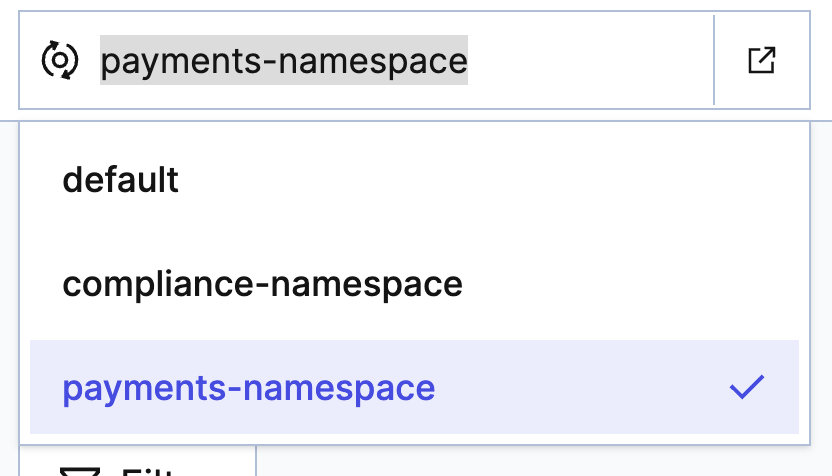
Change the namespace in Temporal UI. You'll find this on the top of the Web UI.
Expected results:
| Transaction | Amount | Route | Risk | Result |
|---|---|---|---|---|
TXN-A | $250 | US → US | LOW | COMPLETED |
TXN-B | $12,000 | US → UK | MEDIUM | COMPLETED |
TXN-C | $75,000 | US → US | HIGH | DECLINED_COMPLIANCE |
Checkpoint 0 passed if all 3 transactions complete with the expected results. The system works! Now let's decouple it.
Stop the Worker (Ctrl+C in Terminal 1) before continuing.
Are you enjoying this tutorial? Feel free to leave feedback with the Feedback widget on the side and sign up here to get notified when we drop new educational content!
Nexus Building Blocks
Before diving into code, here's a quick map of the 4 Nexus concepts you'll encounter:
Service    →    Operation    →    Endpoint      →      Registry
(contract)      (method)          (routing rule)      (directory)
- Nexus Service — A named collection of operations — the contract between teams. In this tutorial, that's the
ComplianceNexusServiceinterface. Think of it like the Activity interface you already have, but shared across services instead of internal to one Worker. - Nexus Operation — A single callable method on a Service, marked with
@Operation(e.g.,checkCompliance). This is the Nexus equivalent of an Activity method — the actual work the other team exposes. - Nexus Endpoint — A named routing rule that connects a caller to the right Namespace and Task Queue, so the caller doesn't need to know where the handler lives. You create
compliance-endpointand point it at thecompliance-risktask queue. - Nexus Registry — The directory in Temporal where all Endpoints are registered. You register the endpoint once; callers look it up by name.
Quick match — test yourself!
Can you match each Nexus concept to what it represents in our payments scenario?
The TODOs
Pre-provided: The
ComplianceWorkflowinterface and implementation are already complete in the exercise. They use Temporal patterns you've already seen —@WorkflowMethod,@UpdateMethod, andWorkflow.await(). Your work starts at TODO 1 — the Nexus-specific parts.
| # | File | Action | Key Concept |
|---|---|---|---|
| 1 | shared/nexus/ComplianceNexusService.java | Your work | @Service + @Operation on both operations |
| 2 | compliance/temporal/ComplianceNexusServiceImpl.java | Your work | fromWorkflowHandle (async) + OperationHandler.sync (sync) |
| 3 | compliance/temporal/ComplianceWorkerApp.java | Your work | Register workflow + Activity + Nexus handler |
| 4 | payments/temporal/PaymentProcessingWorkflowImpl.java | Modify | Replace Activity stub → Nexus stub |
| 5 | payments/temporal/PaymentsWorkerApp.java | Modify | Add NexusServiceOptions, remove ComplianceActivity |
Teaching order: Service interface (1) → Both handlers (2) → Worker (3, CLI) → Caller (4-5) → Run the human review path.
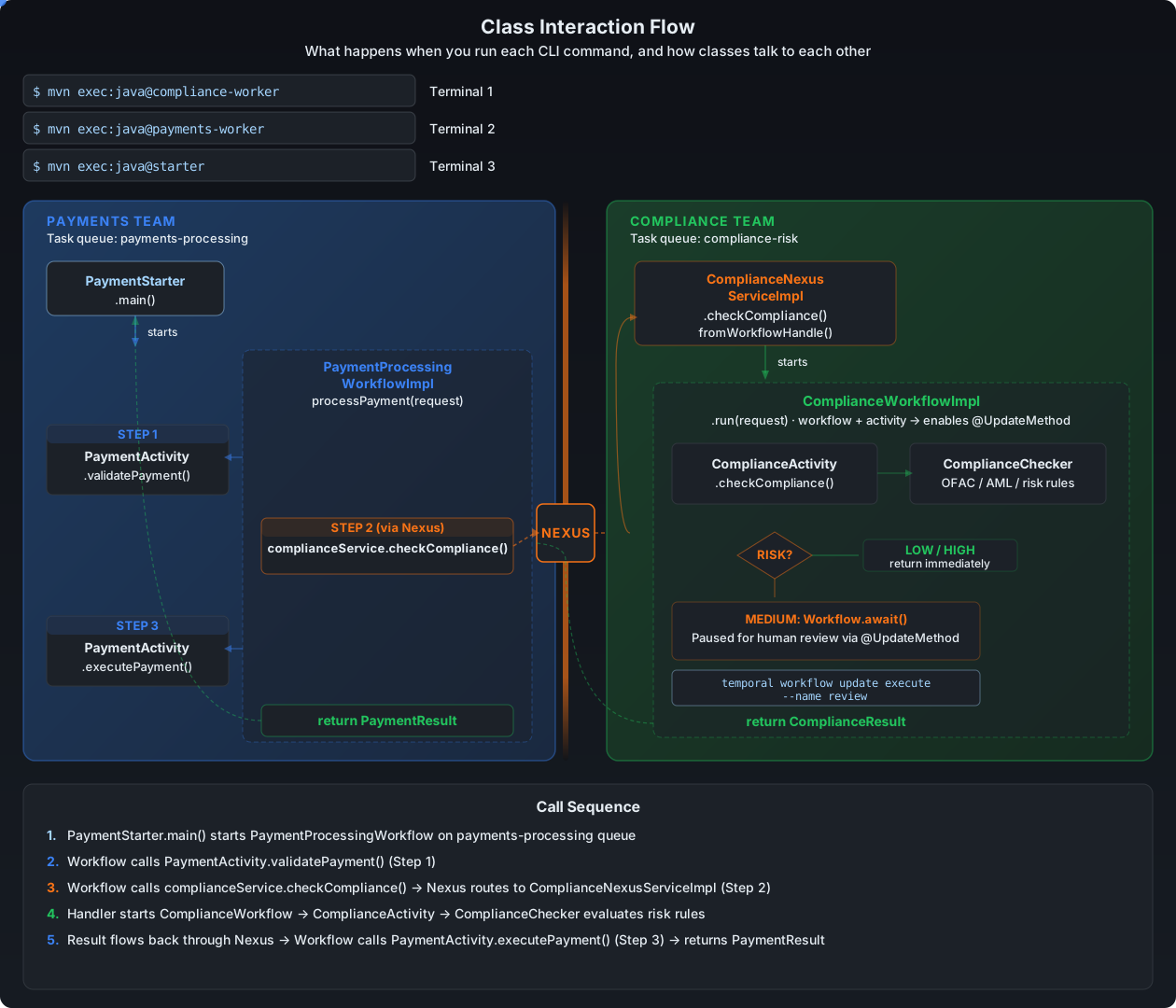
What we're building
Class Interaction Flow
The Compliance Workflow (already in the exercise)
Files: compliance/temporal/workflow/ComplianceWorkflow.java and ComplianceWorkflowImpl.java
Open them and read the code - they show the human-in-the-loop pattern you'll wire up through Nexus later. Here's the interface:
@WorkflowInterface
public interface ComplianceWorkflow {

    @WorkflowMethod
    ComplianceResult run(ComplianceRequest request);

    @UpdateMethod
    ComplianceResult review(boolean approved, String explanation);

    @UpdateValidatorMethod(updateName = "review")
    void validateReview(boolean approved, String explanation);
}
Let's look at the three methods:
run()(@WorkflowMethod) - The main entry point. CallsComplianceActivityto score the transaction's risk, then sleeps 10s (for the Checkpoint 3 durability demo). For LOW and HIGH risk, it returns immediately with an auto-approve or auto-deny. For MEDIUM risk, it callsWorkflow.await()to durably pause until a human reviewer submits a decision.review()(@UpdateMethod) - Receives the human reviewer's approve/deny decision while the workflow is paused. Stores the result and unblocksrun(), which then returns the finalComplianceResult.validateReview()(@UpdateValidatorMethod) - A guard that rejects review Updates that arrive at the wrong time (e.g., before the workflow is waiting for review, or after a decision has already been made).
Why a workflow, not just an Activity? Using a workflow unlocks @UpdateMethod for MEDIUM-risk transactions - the workflow can pause and wait durably for a human reviewer's decision. A plain Activity can't do that. In the future, simple cases might just use an Activity, but a workflow gives you durability and human escalation for free.
Your work starts below at TODO 1.
TODO 1: Create the Nexus Service Interface
File: shared/nexus/ComplianceNexusService.java
This is the shared contract between teams — like an OpenAPI spec, but durable. Both teams depend on this interface.
What to add for TODO 1:
@Serviceannotation on the interface - this registers the interface as a Nexus Service so Temporal knows it's a cross-team contract, not just a regular Java interface.@Operationannotation on both methods - this marks each method as a callable Nexus Operation. Without it, the method is just a Java method signature that Temporal won't expose through the Nexus boundary.
The Nexus runtime validates all methods in a @Service interface at Worker startup. Every method must have @Operation — even ones you won't call right away — or the Worker will fail with Missing @Operation annotation.
Pattern to follow:
@Service
public interface ComplianceNexusService {
    @Operation
    ComplianceResult checkCompliance(ComplianceRequest request);

    @Operation
    ComplianceResult submitReview(ReviewRequest request);
}
Look in the solution directory of the exercise repository if you need a hint!
TODO 2: Implement the Nexus Handlers
File: compliance/temporal/ComplianceNexusServiceImpl.java
This class implements both Nexus operations. You'll use two different handler patterns — one for starting a long-running workflow, one for interacting with an already-running workflow.
Just like the interface needs @Operation on every method, the handler class needs an @OperationImpl method for every operation — or the Worker will fail at startup with Missing handlers for service operations.
Add two new annotations:
@ServiceImpl(service = ComplianceNexusService.class)— on the class@OperationImpl— on each handler method
2a: checkCompliance — async handler (fromWorkflowHandle)
This handler receives compliance check requests from Payments. Instead of running business logic directly, it uses WorkflowRunOperation.fromWorkflowHandle() to start a ComplianceWorkflow and return a handle that binds the Nexus operation to that workflow's ID. On retries (transient failures), Temporal matches on the handle and reuses the existing workflow instead of starting a duplicate.

Step 1: Annotate the class with @ServiceImpl to link it to the service interface:
@ServiceImpl(service = ComplianceNexusService.class)
public class ComplianceNexusServiceImpl {
Step 2: Create an @OperationImpl method that returns an OperationHandler. Use WorkflowRunOperation.fromWorkflowHandle - this is the pattern for wiring a Nexus operation to a long-running workflow:
    @OperationImpl
    public OperationHandler<ComplianceRequest, ComplianceResult> checkCompliance() {
        return WorkflowRunOperation.fromWorkflowHandle((ctx, details, input) -> {
Step 3: Inside the lambda, get a WorkflowClient from the Nexus context, create a workflow stub, and return a WorkflowHandle that links this Nexus operation to the workflow:
            WorkflowClient client = Nexus.getOperationContext().getWorkflowClient();
            ComplianceWorkflow wf = client.newWorkflowStub(
                    ComplianceWorkflow.class,
                    WorkflowOptions.newBuilder()
                            .setTaskQueue("compliance-risk")
                            .setWorkflowId("compliance-" + input.getTransactionId())
                            .build());

            return WorkflowHandle.fromWorkflowMethod(wf::run, input);
        });
    }
2b: submitReview — sync handler (OperationHandler.sync)
This handler receives a review decision (approve/deny) and forwards it to the already-running ComplianceWorkflow as a Workflow Update.
Use OperationHandler.sync because the Update returns immediately — the workflow just stores the result. This completes well within the 10-second sync handler deadline.
    @OperationImpl
    public OperationHandler<ReviewRequest, ComplianceResult> submitReview() {
        return OperationHandler.sync((ctx, details, input) -> {
            WorkflowClient client = Nexus.getOperationContext().getWorkflowClient();
            ComplianceWorkflow wf = client.newWorkflowStub(
                    ComplianceWorkflow.class,
                    "compliance-" + input.getTransactionId());
            return wf.review(input.isApproved(), input.getExplanation());
        });
    }
OperationHandler.syncmust complete within 10 seconds. This is fine here because thereview()Update returns immediately. Any slow operation (Activity, sleep, await) must go in a workflow started viafromWorkflowHandle.
Key differences between the two handlers:
checkCompliance (2a) | submitReview (2b) | |
|---|---|---|
| Pattern | fromWorkflowHandle | OperationHandler.sync |
| What it does | Starts a new long-running workflow | Sends Update to an existing workflow |
| Durability | Async — workflow runs independently | Sync — must complete in 10 seconds |
| Retry behavior | Retries reuse the same workflow | Update is idempotent if workflow ID is stable |
Full code:
@ServiceImpl(service = ComplianceNexusService.class)
public class ComplianceNexusServiceImpl {

    @OperationImpl
    public OperationHandler<ComplianceRequest, ComplianceResult> checkCompliance() {
        return WorkflowRunOperation.fromWorkflowHandle((ctx, details, input) -> {
            WorkflowClient client = Nexus.getOperationContext().getWorkflowClient();
            ComplianceWorkflow wf = client.newWorkflowStub(
                    ComplianceWorkflow.class,
                    WorkflowOptions.newBuilder()
                            .setTaskQueue("compliance-risk")
                            .setWorkflowId("compliance-" + input.getTransactionId())
                            .build());

            return WorkflowHandle.fromWorkflowMethod(wf::run, input);
        });
    }

    @OperationImpl
    public OperationHandler<ReviewRequest, ComplianceResult> submitReview() {
        return OperationHandler.sync((ctx, details, input) -> {
            WorkflowClient client = Nexus.getOperationContext().getWorkflowClient();
            ComplianceWorkflow wf = client.newWorkflowStub(
                    ComplianceWorkflow.class,
                    "compliance-" + input.getTransactionId());
            return wf.review(input.isApproved(), input.getExplanation());
        });
    }
}
Quick Check
Q1: What does @ServiceImpl(service = ComplianceNexusService.class) tell Temporal?
@ServiceImpl links the handler class to its Nexus service interface. Temporal uses this to route incoming Nexus operations to the correct handler.Q2: Why does the handler start a workflow instead of calling ComplianceChecker.checkCompliance() directly?
TODO 3: Create the Compliance Worker
File: compliance/temporal/ComplianceWorkerApp.java
Standard CRWL pattern, but now with three registrations. Open the file - you'll see the Connect, Factory, and Launch steps are already written. The registration lines are commented out.
C — Connect to Temporal
R — Create factory and Worker on "compliance-risk"
W — Wire:
    1. worker.registerWorkflowImplementationTypes(ComplianceWorkflowImpl.class)
    2. worker.registerActivitiesImplementations(new ComplianceActivityImpl(new ComplianceChecker()))
    3. worker.registerNexusServiceImplementation(new ComplianceNexusServiceImpl())
L — Launch
Uncomment the three lines inside the "Wire" section:
// TODO: W — Register workflow, activity, and Nexus handler
worker.registerWorkflowImplementationTypes(ComplianceWorkflowImpl.class);
worker.registerActivitiesImplementations(new ComplianceActivityImpl(new ComplianceChecker()));
worker.registerNexusServiceImplementation(new ComplianceNexusServiceImpl());
The first two are patterns you already know. The third is new - registerNexusServiceImplementation registers your Nexus handler so the Worker can receive incoming Nexus calls. Same shape, different method name.
Task queue: compliance-risk — remember this value. You'll use it again in Checkpoint 1.5 when you create the Nexus endpoint. The endpoint routes incoming Nexus calls to a task queue; the Worker polls that same queue to pick them up. They must match.
Checkpoint 1: Compliance Worker Starts
cd exercise
mvn compile exec:java@compliance-worker
Checkpoint 1 passed if you see:
Compliance Worker started on: compliance-risk
If it fails to compile or crashes at startup, check:
- TODO 1: Does
ComplianceNexusServicehave@Serviceand@Operationon both methods? - TODO 2: Does
ComplianceNexusServiceImplhave@ServiceImpland@OperationImplon both handlers (checkComplianceandsubmitReview)? - TODO 3: Are you registering the Workflow, Activity, and Nexus service?
Keep the compliance Worker running — you'll need it for Checkpoint 2.
Checkpoint 1.5: Create the Nexus Endpoint
Now that the compliance side is built, register the Nexus endpoint with Temporal. This tells Temporal: "When someone calls compliance-endpoint, route it to the compliance-risk task queue in compliance-namespace."
temporal operator nexus endpoint create \
  --name compliance-endpoint \
  --target-namespace compliance-namespace \
  --target-task-queue compliance-risk
You should see:
Endpoint compliance-endpoint created.
Analogy: This is like adding a contact to your phone. The endpoint name is the contact name; the task queue + namespace is the phone number. You only do this once.
Without this, the Payments Worker (TODO 5) won't know where to route ComplianceNexusService calls.
TODO 4: Replace Activity Stub with Nexus Stub
File: payments/temporal/PaymentProcessingWorkflowImpl.java
Key teaching moment: You're swapping one line of code that changes the entire architecture.
Where does the endpoint come from? Not here! The workflow only knows the service (
ComplianceNexusService). The endpoint ("compliance-endpoint") is configured in the Worker (TODO 5). This keeps the workflow portable - you can point it at a different endpoint in staging vs production without changing workflow code.
BEFORE:
private final ComplianceActivity complianceActivity =
    Workflow.newActivityStub(ComplianceActivity.class, ACTIVITY_OPTIONS);

// In processPayment():
ComplianceResult compliance = complianceActivity.checkCompliance(compReq);
AFTER:
private final ComplianceNexusService complianceService = Workflow.newNexusServiceStub(
    ComplianceNexusService.class,
    NexusServiceOptions.newBuilder()
        .setOperationOptions(NexusOperationOptions.newBuilder()
            .setScheduleToCloseTimeout(Duration.ofMinutes(10))
            .build())
        .build());

// In processPayment():
ComplianceResult compliance = complianceService.checkCompliance(compReq);
What changed: Drag each Nexus replacement to its monolith equivalent:
TODO 5: Update the Payments Worker
File: payments/temporal/PaymentsWorkerApp.java
Two changes:
CHANGE 1: Register both workflows with NexusServiceOptions (maps service to endpoint):
worker.registerWorkflowImplementationTypes(
    WorkflowImplementationOptions.newBuilder()
        .setNexusServiceOptions(Collections.singletonMap(
            "ComplianceNexusService",      // interface name (no package)
            NexusServiceOptions.newBuilder()
                .setEndpoint("compliance-endpoint")  // matches CLI endpoint
                .build()))
        .build(),
    PaymentProcessingWorkflowImpl.class,
    ReviewCallerWorkflowImpl.class);       // both workflows use the same Nexus endpoint
CHANGE 2: Remove ComplianceActivityImpl registration:
// DELETE these lines:
ComplianceChecker checker = new ComplianceChecker();
worker.registerActivitiesImplementations(new ComplianceActivityImpl(checker));
Analogy: You're removing the compliance department from your building and adding a phone extension to their new office. The workflow dials the same number (
checkCompliance), but the call now routes across the street.
Checkpoint 2: Decoupled End-to-End (Automated Decisions)
You need 3 terminal windows now:
Terminal 0: Temporal server (already running)
Terminal 1 — Compliance Worker (already running from Checkpoint 1, or restart):
cd exercise
mvn compile exec:java@compliance-worker
Terminal 2 — Payments Worker (restart with your changes):
cd exercise
mvn compile exec:java@payments-worker
Terminal 3 — Starter:
cd exercise
mvn compile exec:java@starter
TXN-A and TXN-C each take about 10 seconds (the compliance workflow includes a durable sleep to demonstrate Checkpoint 3). TXN-B ($12K, US→UK) is MEDIUM risk - its ComplianceWorkflow scores the risk, then calls Workflow.await() to durably pause until a human reviewer submits a decision via the @UpdateMethod. Until that Update arrives, the workflow (and the Nexus operation bound to it) just waits. That's expected - you'll complete the human review path after Checkpoint 3.
Checkpoint 2 passed if you see these results:
| Transaction | Risk | Result | How |
|---|---|---|---|
TXN-A | LOW | COMPLETED | Auto-approved (~10s) |
TXN-B | MEDIUM | Waiting | Paused for human review (you'll complete this after Checkpoint 3) |
TXN-C | HIGH | DECLINED_COMPLIANCE | Auto-denied (~10s, amount > $50K) |
Two Workers, two blast radii, two independent teams. The automated compliance path works end-to-end through Nexus.
Check the Temporal UI at http://localhost:8233 — you should see Nexus operations in the workflow Event History!
Checkpoint 3: Durability Across the Boundary
This is where it gets fun. Let's prove that Nexus is durable.
Make sure both Workers are running and that any previous workflows have completed or been terminated.
Terminal 3 — Run the starter:
cd exercise
mvn compile exec:java@starter
The starter runs TXN-A first. TXN-A has a 10-second durable sleep in ComplianceWorkflowImpl. During that 10-second window:
Terminal 1 — Kill the compliance Worker (Ctrl+C)
Now watch what happens:
- Terminal 3 (starter) — hangs. It's waiting for the TXN-A result. No crash, no error.
- Temporal UI (http://localhost:8233) — open the
payment-TXN-Aworkflow. You'll see the Nexus operation in a backing off state. Temporal knows the compliance Worker is gone and is waiting for it to come back.
Terminal 1 — Restart the compliance Worker:
cd exercise
mvn compile exec:java@compliance-worker
Now watch:
- Terminal 1 (compliance Worker) — picks up the work immediately. You'll see
[ComplianceChecker] Evaluating TXN-Ain the logs. - Terminal 3 (starter) — TXN-A completes with
COMPLETED. The starter moves on to TXN-B and TXN-C as if nothing happened. - Temporal UI — the Nexus operation shows as completed. No retries of the payment workflow. No duplicate compliance checks. The system just resumed.
Checkpoint 3 passed if TXN-A completes successfully after you restart the compliance Worker.
What just happened: The payment workflow didn't crash. It didn't timeout. It didn't lose data. It didn't need retry logic. It just... waited. When the compliance Worker came back, Temporal automatically routed the pending Nexus operation to it. Durability extends across the team boundary — that's the whole point of Nexus.
Complete the Human Review Path
You already implemented both handlers in TODO 2 — checkCompliance (async, fromWorkflowHandle) and submitReview (sync, OperationHandler.sync). Now let's use submitReview to approve TXN-B's MEDIUM-risk transaction.
Checkpoint: Approve TXN-B via Nexus
Make sure both Workers are running and TXN-B is still waiting from Checkpoint 2. If you need to restart, run the starter again first.
Terminal 4 — Approve TXN-B via Nexus:
cd exercise
mvn compile exec:java@review-starter
This starts a ReviewCallerWorkflow in the payments namespace that calls the submitReview Nexus operation. The Compliance team's sync handler receives it, looks up the compliance-TXN-B workflow, and sends the review Update — all through the Nexus boundary, with no direct access to the compliance workflow internals.
Want to deny instead? Edit
ReviewStarter.java, changetruetofalse, and re-run.
You should see the review result returned in Terminal 4, and back in Terminal 3, TXN-B completes with COMPLETED.
Checkpoint passed if TXN-B completes with COMPLETED after running the review starter.
Quiz
Test your understanding before moving on:
Q1: Where is the Nexus endpoint name (compliance-endpoint) configured?
PaymentsWorkerApp, via NexusServiceOptions → setEndpoint("compliance-endpoint"). The workflow only knows the service interface. The Worker knows the endpoint. This separation keeps the workflow portable.Q2: What happens if the Compliance Worker is down when the Payments workflow calls checkCompliance()?
scheduleToCloseTimeout expires (10 minutes in our case). If the Compliance Worker comes back within that window, the operation completes successfully. The Payment workflow just waits — no crash, no data loss.Q3: What's the difference between @Service/@Operation and @ServiceImpl/@OperationImpl?
@Service/@Operationgo on the interface — the shared contract both teams depend on@ServiceImpl/@OperationImplgo on the handler class — the implementation that only the Compliance team owns
Think of it as: the interface is the menu (shared), the handler is the kitchen (private).
Q4: What's wrong with using OperationHandler.sync() to back a Nexus operation with a long-running workflow?
sync() starts a workflow and blocks for its result in a single handler call. If the Nexus operation retries (which happens during timeouts or transient failures), the handler runs again from scratch — starting a duplicate workflow each time.The fix is WorkflowRunOperation.fromWorkflowHandle(), which returns a handle (like a receipt number) binding the Nexus operation to that workflow's ID. On retries, the infrastructure sees the handle and reuses the existing workflow instead of creating a new one.
Bad (creates duplicates on retry):
OperationHandler.sync((ctx, details, input) -> {
    WorkflowClient client = Nexus.getOperationContext().getWorkflowClient();
    ComplianceWorkflow wf = client.newWorkflowStub(...);
    WorkflowClient.start(wf::run, input);
    return WorkflowStub.fromTyped(wf).getResult(ComplianceResult.class);
});
Good (retries reuse the same workflow):
WorkflowRunOperation.fromWorkflowHandle((ctx, details, input) -> {
    WorkflowClient client = Nexus.getOperationContext().getWorkflowClient();
    ComplianceWorkflow wf = client.newWorkflowStub(...);
    return WorkflowHandle.fromWorkflowMethod(wf::run, input);
});
Q5: Why does the handler start a workflow instead of calling ComplianceChecker.checkCompliance() directly?
Sync handlers should only contain Temporal primitives — workflow starts and queries. Running arbitrary Java code (like ComplianceChecker.checkCompliance()) in a handler bypasses Temporal's durability guarantees.
The handler starts a ComplianceWorkflow and waits for its result. The actual business logic runs inside an Activity within the workflow, where it gets retries, timeouts, and heartbeats for free. Plus, the workflow can pause for human review via @UpdateMethod — something a direct call could never support.
What You Built
You started with a monolith and ended with two independent services connected through Nexus:
BEFORE (Monolith):                    AFTER (Nexus Decoupled):
┌─────────────────────────┐           ┌──────────────┐    ┌──────────────┐
│   Single Worker         │           │  Payments    │    │  Compliance  │
│   ─────────────         │           │  Worker      │    │  Worker      │
│   Workflow              │           │  ──────      │    │  ──────      │
│   PaymentActivity       │    →      │  Workflow    │◄──►│  NexusHandler│
│   ComplianceActivity    │           │  PaymentAct  │    │  Checker     │
│                         │           │              │    │              │
│   ONE blast radius      │           │  Blast #1    │    │  Blast #2    │
└─────────────────────────┘           └──────────────┘    └──────────────┘
                                                   ▲ Nexus ▲
Key concepts you used:
| Concept | What you did |
|---|---|
@Service + @Operation | Defined the shared contract between teams |
@ServiceImpl + @OperationImpl | Implemented the handler on the Compliance side |
fromWorkflowHandle | Backed a Nexus operation with a long-running workflow (retry-safe) |
OperationHandler.sync | Sent a workflow Update through the Nexus boundary |
Workflow.newNexusServiceStub | Replaced the Activity stub with a Nexus stub (one-line swap) |
NexusServiceOptions | Mapped the service interface to the endpoint in the Worker |
| Nexus Endpoint (CLI) | Registered the routing rule: endpoint name to namespace + task queue |
The fundamental pattern: same method call, different architecture. The workflow still calls checkCompliance() - but the call now crosses a team boundary with full durability.
What's Next?
From here you can explore more advanced patterns - multi-step compliance pipelines, async human escalation chains, or cross-namespace Nexus operations. See the Nexus documentation to go deeper.
Don't forget to sign up here to get notified when we drop new educational content!